Compact but powerful, the portable microscope for pathogen observation in medical labs delivers advanced control for detailed visual analysis. The precision-designed optical pathway and coated lenses reduce glare and optimize image quality. The adjustable stage accommodates multiple slide sizes, and the light source offers steady brightness for long observation periods. The portable microscope for pathogen observation in medical labs is built for durability with low maintenance and reliable operation in high laboratory throughput. It is ideal for professional and academic applications requiring accurate visual results.

Applications of the portable microscope for pathogen observation in medical labs include nanotechnology and public health. In biotechnology, it provides visualization of genes and interactions of cells. In food safety testing, the portable microscope for pathogen observation in medical labs identifies contaminants and microorganisms that affect product quality. In materials engineering, it assists in failure analysis and accurate measurement of microscopic structures. The portable microscope for pathogen observation in medical labs also finds application in archaeology, enabling scientists to study mineral residues and microfossils that reflect environmental conditions in the past.

The future of the portable microscope for pathogen observation in medical labs is influenced by digitalization and smart automation. More efficient imaging sensors will allow the portable microscope for pathogen observation in medical labs to identify three-dimensional structures with unprecedented precision. Artificial intelligence will analyze microscopic images, reduce human errors, and optimize research productivity. Wireless communication and cloud connectivity will facilitate collaboration globally with remote monitoring and immediate data exchange. The portable microscope for pathogen observation in medical labs will be an entirely networked instrument that closes the gap between laboratory precision and data-driven research outcomes.
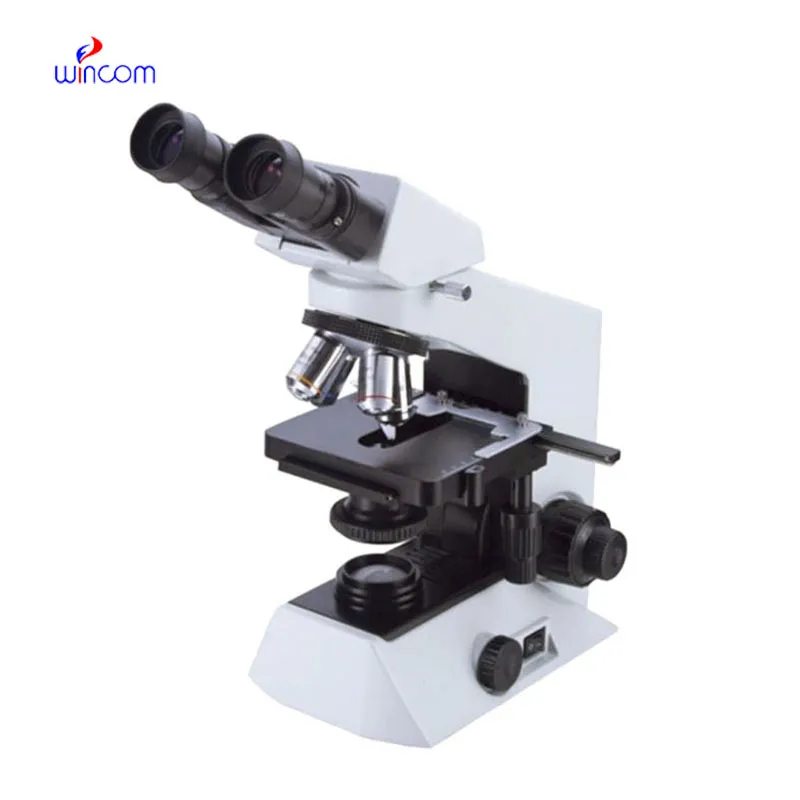
A well-maintained portable microscope for pathogen observation in medical labs gives reliable performance and long operating life. Check optical elements regularly for dust, fingerprint, or oil residue. Use only authorized manufacturer cleaning materials to prevent lens coating damage. Store the portable microscope for pathogen observation in medical labs upright, supported, and covered when not in use. Check focusing mechanisms for smooth operation and illumination system for uniform brightness. Standard maintenance procedures minimize downtime and preserve imaging quality for education and research.
A portable microscope for pathogen observation in medical labs transforms the observation of the unobservable world, revealing patterns, textures, and life beyond the naked eye. It achieves this by illuminating or electronizing a sample by transmitting light or electrons through or above it to produce a magnified image. The portable microscope for pathogen observation in medical labs has widespread uses in science, industry, and education to scan biological tissue, metal surfaces, and nanomaterials. Its ability to unveil subtle details makes it a must-have instrument of observation, measurement, and discovery in modern science.
Q: What distinguishes a digital microscope from a traditional one? A: A digital microscope integrates cameras and imaging software, enabling users to view, capture, and analyze images directly on a computer or monitor. Q: How can vibration affect a microscope? A: Vibration can cause image blur or misalignment, so the microscope should always be placed on a stable, vibration-free surface. Q: What safety measures should be taken when using a microscope? A: Avoid touching optical parts with fingers, use slides carefully, and ensure electrical components are safely connected before operation. Q: Why is immersion oil used in some microscopes? A: Immersion oil increases the refractive index between the lens and specimen, improving resolution and brightness at higher magnifications. Q: How can you prevent mold growth in a microscope? A: Store the microscope in a low-humidity environment and use desiccants or dehumidifiers to keep optical components dry and mold-free.
The delivery bed is well-designed and reliable. Our staff finds it simple to operate, and patients feel comfortable using it.
The centrifuge operates quietly and efficiently. It’s compact but surprisingly powerful, making it perfect for daily lab use.
To protect the privacy of our buyers, only public service email domains like Gmail, Yahoo, and MSN will be displayed. Additionally, only a limited portion of the inquiry content will be shown.
Could you share the specifications and price for your hospital bed models? We’re looking for adjus...
We’re currently sourcing an ultrasound scanner for hospital use. Please send product specification...
E-mail: [email protected]
Tel: +86-731-84176622
+86-731-84136655
Address: Rm.1507,Xinsancheng Plaza. No.58, Renmin Road(E),Changsha,Hunan,China


 EN
 af
 es
 ar
 tr
 sw
 pt
 th
 ur
 bn
 ne
 vi
 km
 lo
 de
 ru
 fi
 nl
 fa
 fr
 ko